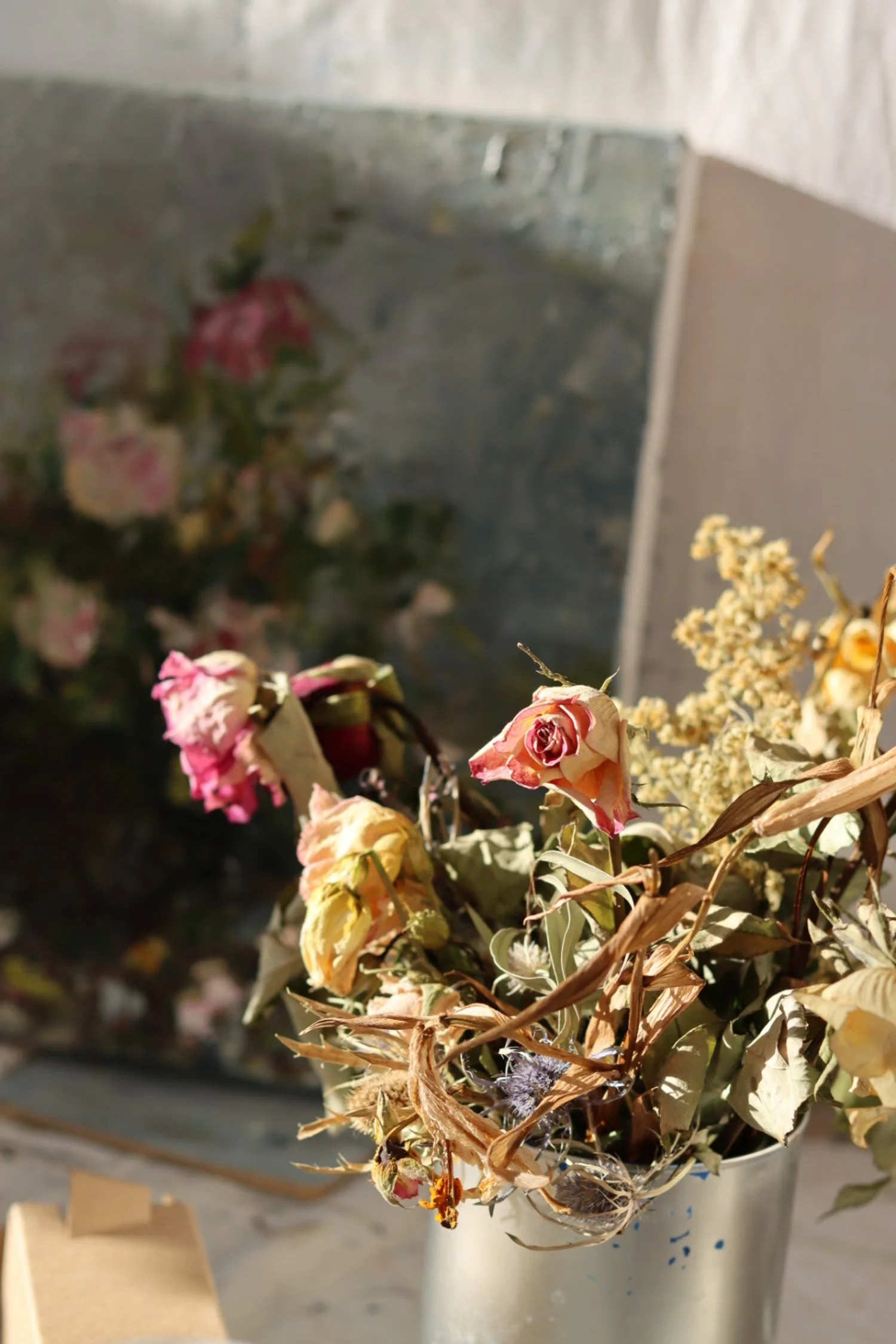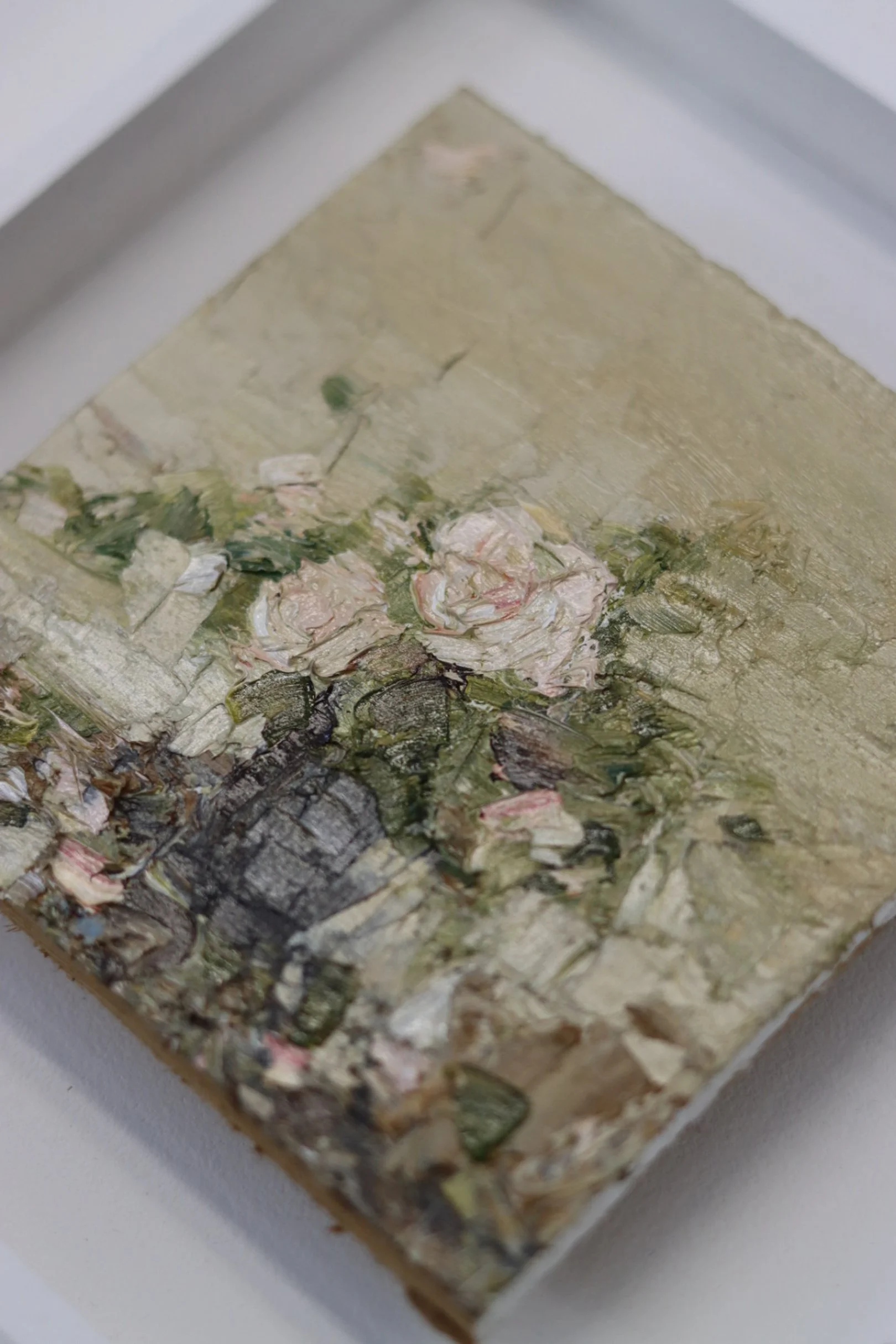
Still life is often described as a genre of rest. A pause. Objects arranged, light held steady, time suspended. The implication is that nothing much happens.
I have never experienced it that way.
Flowers, branches, hedgerows and garden cuttings are among the most unstable subjects a painter can choose. They change hour by hour. They open, collapse, bruise, drop their petals without warning. Even when placed in water, they are already in the process of leaving.
To paint them as fixed or decorative feels dishonest. What interests me is not the flower as an object, but the flower as a moment. As something caught briefly before it moves on.
This is where my still life work begins.
The problem with the word “still”
The word still suggests silence and stasis, but in painting it has always been a kind of misdirection. Historically, still life has carried enormous symbolic weight. Dutch vanitas paintings were never really about flowers or fruit. They were about time passing, bodies ageing, life ending. The wilting bloom was not decorative. It was a warning.
Over time, particularly in domestic and commercial contexts, still life has softened. Flowers became safe. Acceptable. Something to hang without asking too much of the viewer.
That legacy lingers.
When I paint flowers, I am conscious of pushing gently against that assumption. Not through scale alone, though scale helps, but through surface, movement and refusal to resolve everything neatly. I want the painting to feel as if it is still happening. As if the subject might shift if you looked away.
Why flowers keep returning
I often ask myself why I return to these motifs again and again. Hedgerows, cuttings, stems in jars, flowers gathered rather than arranged. There are other subjects I could paint, and do, but these keep asserting themselves.
Part of it is proximity. These are things that exist close to home. In gardens, on walks, at the edges of daily life. When time is limited, as it often is now, the subjects that present themselves are the ones that can be returned to easily. Revisited. Observed over days rather than weeks away.
But there is also something deeper at work.
Flowers allow a kind of freedom. They are recognised, but not fixed. Everyone knows what a flower is, but no one expects a precise likeness. That gives the painter room to move. To prioritise rhythm, colour relationships, weight and balance over description.
In that sense, flowers are generous subjects. They ask to be interpreted rather than recorded.
Painting movement without depicting motion
One of the questions I return to in the studio is how to suggest movement without illustrating it. A flower does not move in the way a figure does. It does not walk or gesture. Its movement is slower, quieter, but no less present.
This is where paint itself becomes crucial.
Palette knives, large brushes, loaded surfaces. These allow the painting to carry its own energy. A dragged knife through wet paint can suggest the sag of a stem, the weight of a bloom pulling downward. Thick passages can hold light differently, catching and releasing it as the viewer moves.
I am not trying to paint the flower moving. I am trying to paint what it feels like to look at something that will not stay as it is.
That difference matters.
Arrangement versus gathering
I rarely arrange flowers in the traditional sense. I do not spend long composing a still life, adjusting stems until they sit just so. Instead, I gather. Cuttings from the garden. Things picked up on walks. Whatever is at hand.
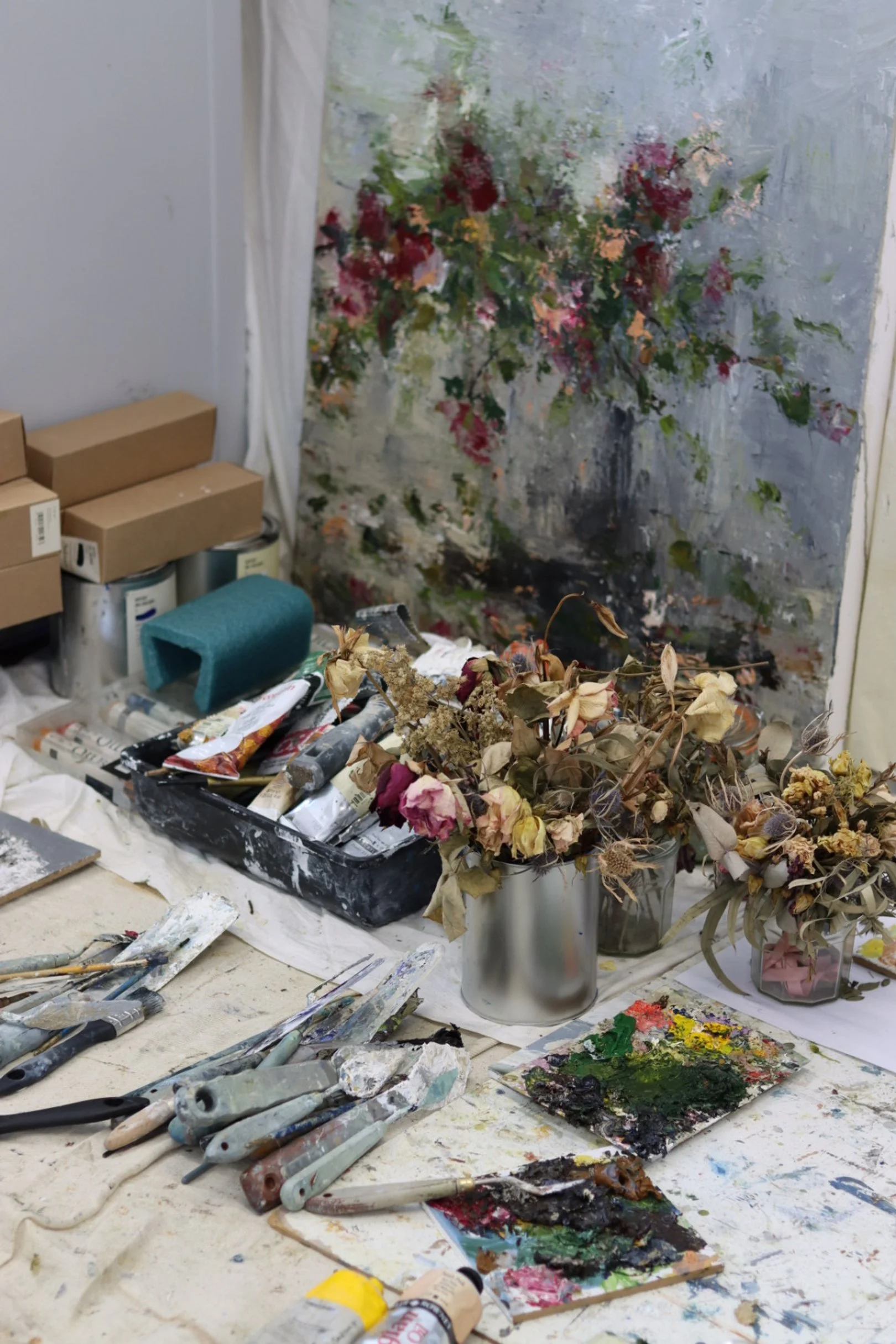
The resulting compositions are slightly awkward. Asymmetric. Sometimes unbalanced. They lean. They crowd. They refuse the kind of elegance that comes from too much control.
This feels important to me.
An overly arranged still life can become about taste rather than attention. I am more interested in the act of looking than in presenting something beautiful in a conventional sense. Beauty, when it arrives, should feel incidental rather than imposed.
The domestic and the serious
Flowers have long been associated with the domestic, and by extension with work that has historically been undervalued. Decorative arts, women’s work, things done quietly and close to home.
There is a quiet politics in insisting that these subjects are worthy of sustained attention.
Painting flowers seriously does not mean painting them reverently or prettily. It means allowing them to carry the same weight as any other subject. It means scale, ambition and commitment. It means not apologising for subject matter that has been dismissed in the past.
In my own practice, this has become more pronounced since becoming a mother. The domestic is no longer something I step away from in order to work. It is the context in which the work happens. That does not make the work smaller. If anything, it sharpens it.
Colour as structure
In still life painting, colour often does more structural work than drawing. I am less concerned with outlining forms than with how colours sit against one another. How a green shifts when placed beside a pink. How a neutral can hold a composition together.
I tend to work intuitively, adjusting as I go, responding to what the painting needs rather than following a pre planned palette. This can feel risky. There is no map. But over time, a kind of internal logic develops.
Certain colours recur. Ochres, muted greens, soft blues, flashes of something brighter held back by earth tones. These are not chosen to be harmonious in a decorative sense. They are chosen because they feel true to the experience of looking.
Still life, for me, is not about describing colour accurately. It is about describing the sensation of colour in relation to light, surface and mood.
When a painting resists you
Still life paintings often reach a point of resistance. A moment where nothing seems to work. The surface becomes heavy. The relationships feel strained. This is usually where the temptation to fix things becomes strongest.
Over time, I have learned to see this resistance as a signal rather than a problem. It often means that the painting is asking for less, not more. A pause. A step back. Sometimes days of distance.
Because flowers change so quickly, there is an added pressure to resolve the painting before the subject collapses entirely. But chasing the subject rarely leads anywhere good. The painting has to find its own resolution, independent of the original arrangement.
Some of the strongest still life paintings I have made no longer resemble the flowers that prompted them. They have become something else. A record of attention rather than a record of objects.
Impermanence as content
At its core, still life is always about impermanence. About the fact that nothing stays as it is. Flowers simply make this impossible to ignore.
I am not interested in freezing that moment or pretending otherwise. I want the painting to acknowledge change, even as it holds something briefly in place.
This is where still life intersects with everything else I paint. Landscapes shift. Light moves. The sea never repeats itself. Still life is not separate from these concerns. It is simply a more intimate way of approaching them.
The quiet refusal to be decorative is not a rejection of beauty. It is a refusal to let beauty be the only thing that is seen.
Why this work matters to me now
There are periods in a painter’s life when certain subjects feel more urgent than others. Right now, still life feels essential. Not as a retreat, but as a way of paying close attention within limited time.
These paintings are made quickly, but they are not rushed. They are concentrated. They carry the intensity of short sessions and the discipline of stopping before things unravel.
They sit alongside larger works and exhibitions, but they also stand on their own. Small moments held with care.
In a world that increasingly demands spectacle, still life offers a different proposition. Slow looking. Quiet engagement. A recognition that significance does not always announce itself loudly.
That feels worth insisting on.