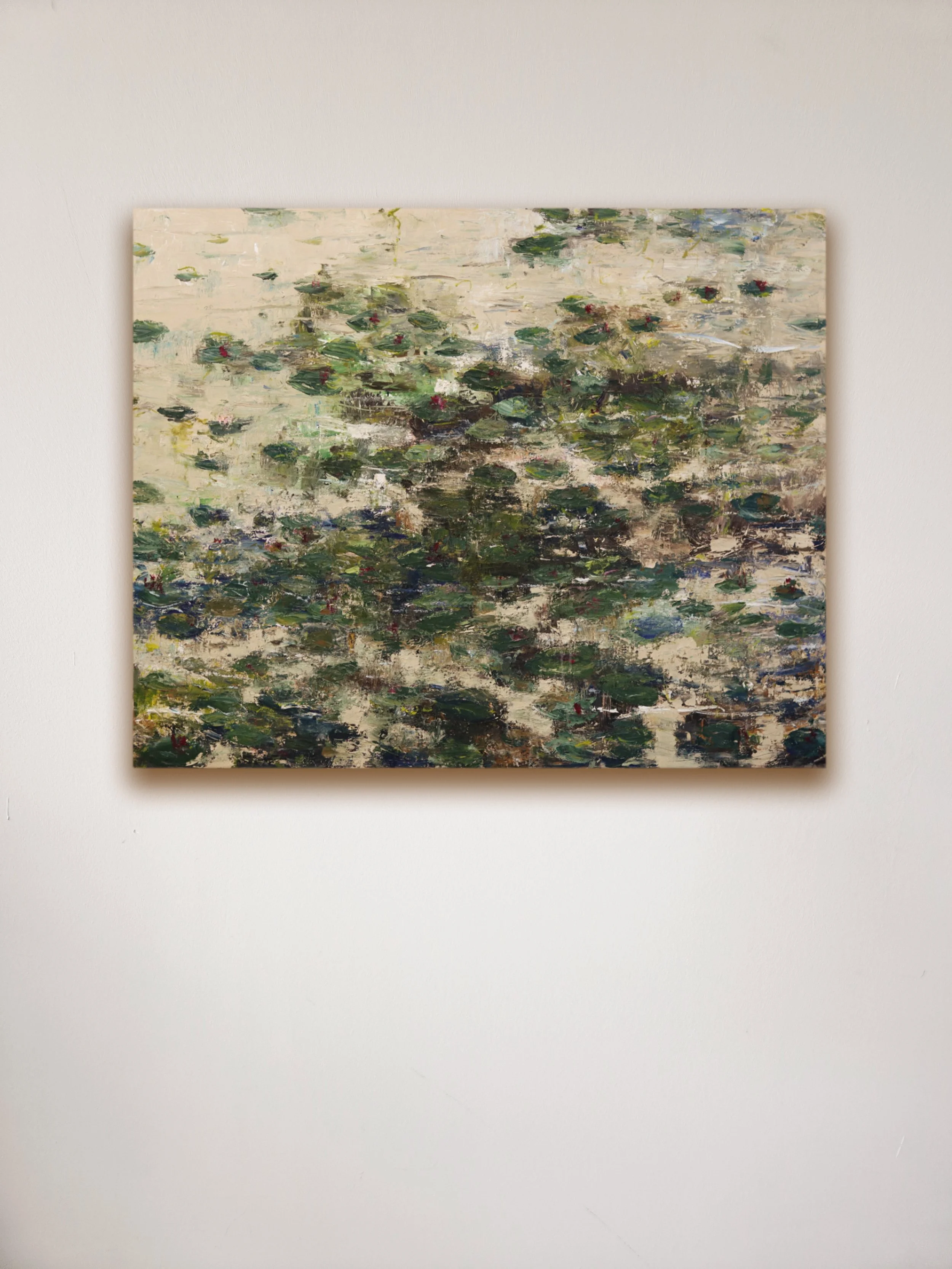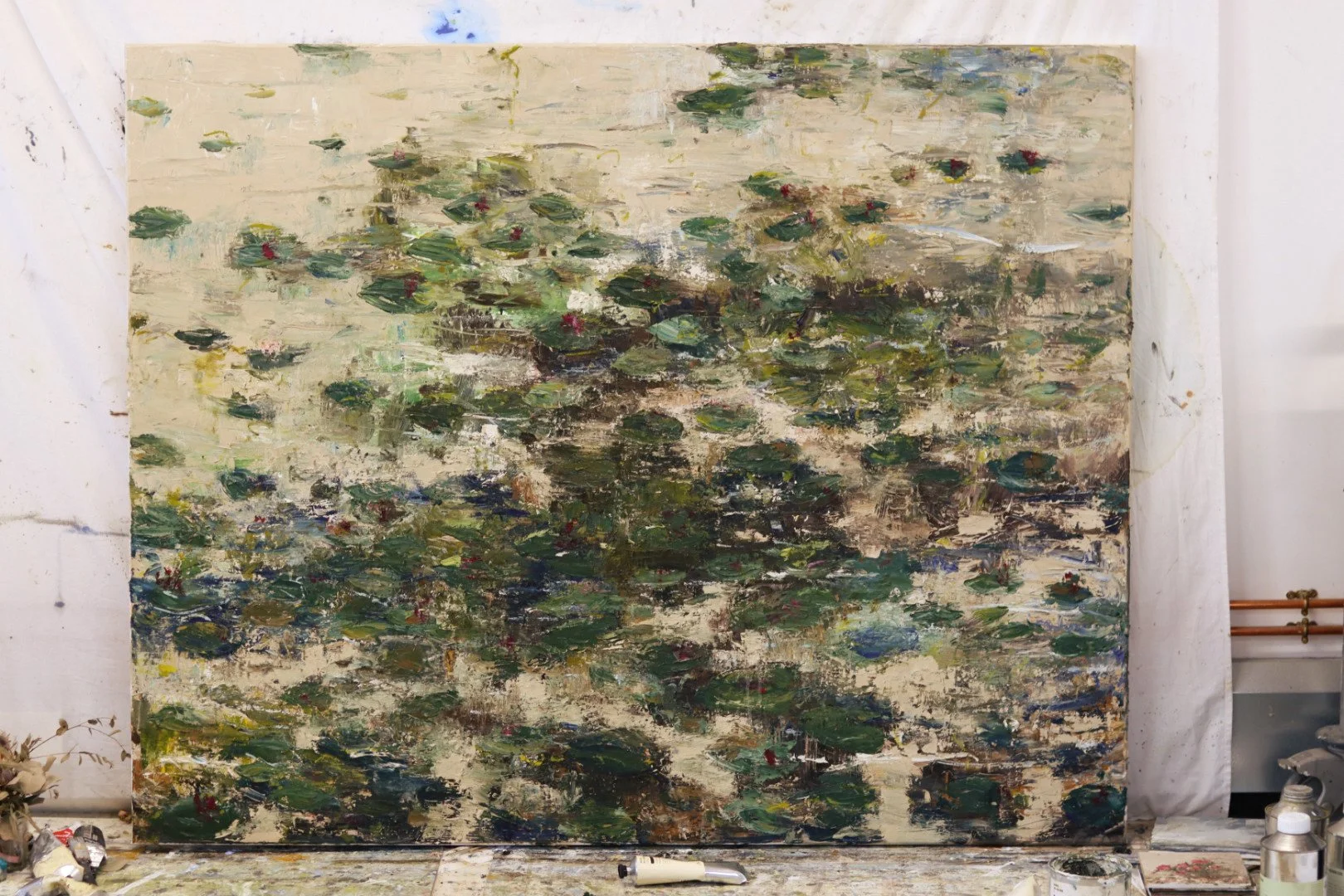
This painting began without a plan. That feels important to say, because increasingly I am interested in what happens when intention loosens its grip and something quieter is allowed to take over. Waterlilies, as a subject, arrived not as an image I wanted to replicate, but as a sensation. A memory of light sitting on water. Of growth and weight and stillness all existing at once.
In the studio, the early stages were slow. I worked the surface back and forth, building layers and then interrupting them, never quite letting the painting settle. Greens emerged first, but not the decorative kind. These were muddied, weighted, mixed with earth tones and muted light. I wanted the surface to feel worked, almost weathered, as if time itself had passed through it.
I often think about how much of painting is really about resisting clarity. There is a temptation, especially when something begins to resemble a recognisable subject, to push it further, to make it legible. With this piece, I deliberately pulled back. Forms appear and dissolve. Shapes suggest foliage or reflection, but nothing insists on being named. The painting lives in that uncertain space between seeing and remembering.
Water has always interested me as a motif, not because of its visual beauty alone, but because of what it does to perception. It distorts, softens, fragments. It refuses fixed edges. In this painting, that quality became a structural guide rather than a theme. Layers sit on top of one another in a way that mimics reflection rather than depth. The eye moves across the surface without finding a single point of rest, and that feels true to the experience of looking into water rather than at it.
Scale matters here. At 120 by 150 centimetres, the painting holds its own physically. It is large enough to enter into your field of vision without shouting. I think of it less as an image and more as a presence. Something that changes depending on where you stand, how the light falls, how long you stay with it. From a distance, the composition feels cohesive, almost calm. Up close, it breaks apart into marks, scrapes, softer passages and moments of abrasion.
There is a tension I am always trying to hold between control and surrender. This painting tested that balance. There were moments where it felt unresolved, even awkward, and I had to sit with that discomfort rather than fix it. I have learnt that those moments often lead somewhere more honest if I allow them the time they need. The surface bears traces of hesitation as much as confidence, and I no longer see that as something to hide.
As with much of my recent work, this painting was made alongside the rhythms of daily life rather than in isolation from it. The studio hours are fragmented. Paintings are started, paused, returned to. That stop start process leaves its own imprint. I think it mirrors the way memory works, how experiences are layered and revisited rather than completed neatly. The painting carries that sense of accumulation, of time folding in on itself.
There is also something about waterlilies themselves that feels quietly defiant. They grow where conditions are unstable, anchored below the surface while appearing effortless above it. That duality resonates with me. The visible calm and the unseen labour beneath. It felt important not to romanticise that idea too much, but to let it sit as a quiet undercurrent within the work.
Colour played a crucial role in holding everything together. The palette is restrained, but not minimal. Greens are offset by earth tones and softened light, creating a push and pull between warmth and coolness. I wanted the painting to feel alive rather than decorative, grounded rather than pretty. Subtle shifts in tone do most of the work, revealing themselves slowly rather than announcing themselves immediately.
When the painting finally began to settle, it was not because it resolved into a clear image, but because it reached a point of balance. The surface felt active but not restless. Open but not empty. That is usually how I know a painting is finished, when adding more would not deepen it, only explain it.
Living with the painting in the studio before it left was an important part of the process. I noticed how it changed throughout the day, how certain areas came forward in morning light and receded again by evening. It is a work that asks for time, both in its making and in its viewing. It does not reveal itself all at once, and I like that. It mirrors the way we experience landscapes, memories, and even ourselves, in fragments rather than complete narratives.
This painting is not about waterlilies in a literal sense. It is about atmosphere, accumulation, and the quiet movement of things beneath the surface. It holds space for ambiguity, and I hope it offers something different each time it is encountered. A place to pause. A place to look without needing to arrive anywhere in particular.