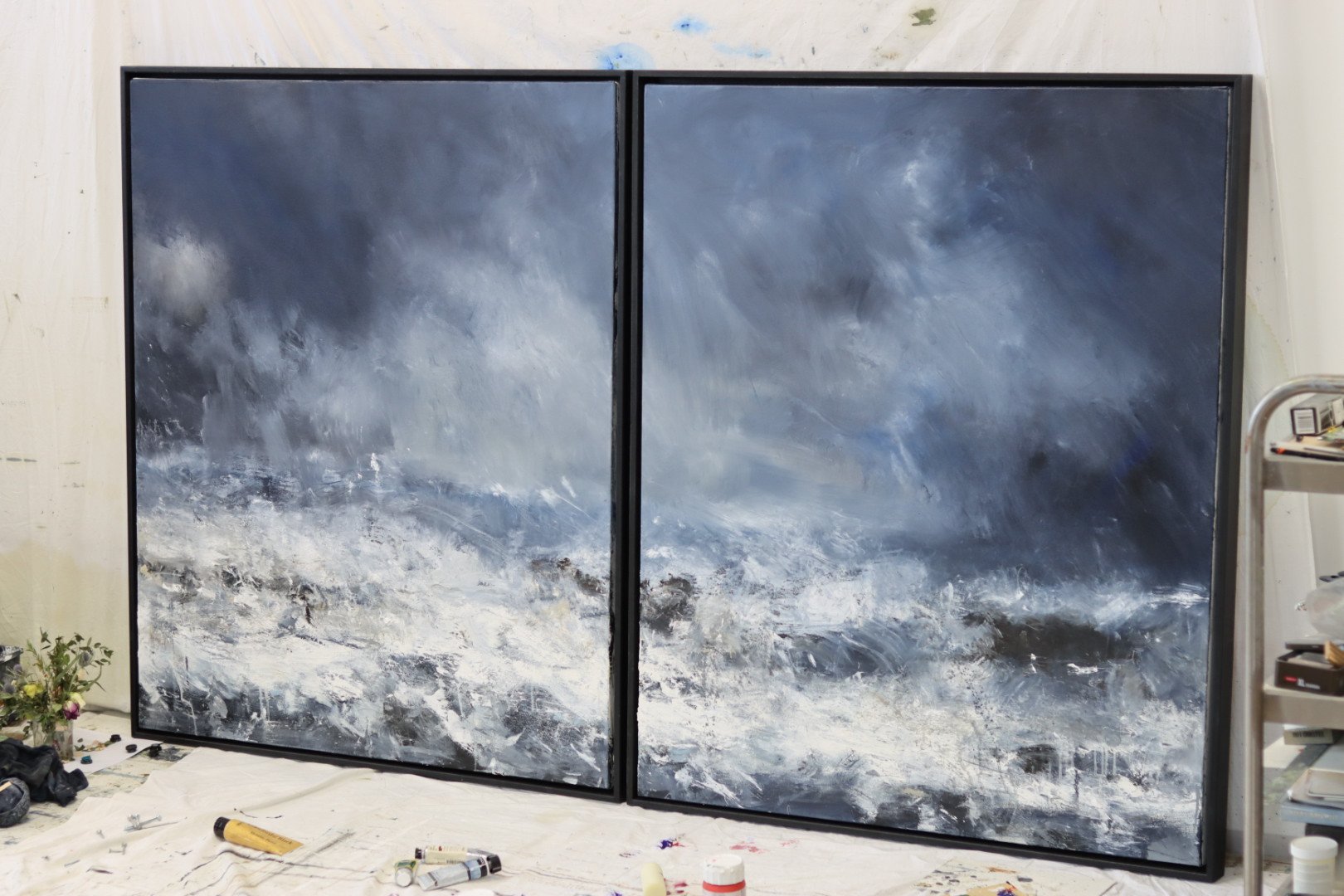
There is a particular moment that happens in the studio when a painting refuses to remain small.
It is not something that can always be explained beforehand. The idea may begin modestly enough, a thought about colour, a memory of light across water, a fleeting impression of wild flowers seen from a car window. But when the canvas appears, it becomes clear almost immediately that the painting will not fit inside the boundaries you first imagined for it. Some paintings insist on space.
Scale in painting is not simply about size. It is about experience. A large painting is not merely a bigger object on the wall. It alters the way a viewer encounters the work. Where a small painting invites the eye to come closer, a large painting surrounds the viewer. It changes the physical relationship between the painting and the body standing in front of it. For certain subjects, this relationship matters enormously.
When I think about the landscapes and seascapes that inform much of my work, they are not small experiences. The coastline, for instance, is not something that can be contained easily. The horizon extends further than the eye can comfortably follow. The wind moves through space in a way that feels expansive. The light shifts across water and land in wide, slow gestures.
Trying to compress that sense of openness into a very small format can sometimes feel like trying to hold the sea inside a cup.
Of course, small paintings have their own quiet authority. They can be intimate, precise, concentrated. But some ideas resist that intimacy. They demand something more physical, something that allows the painting to breathe.
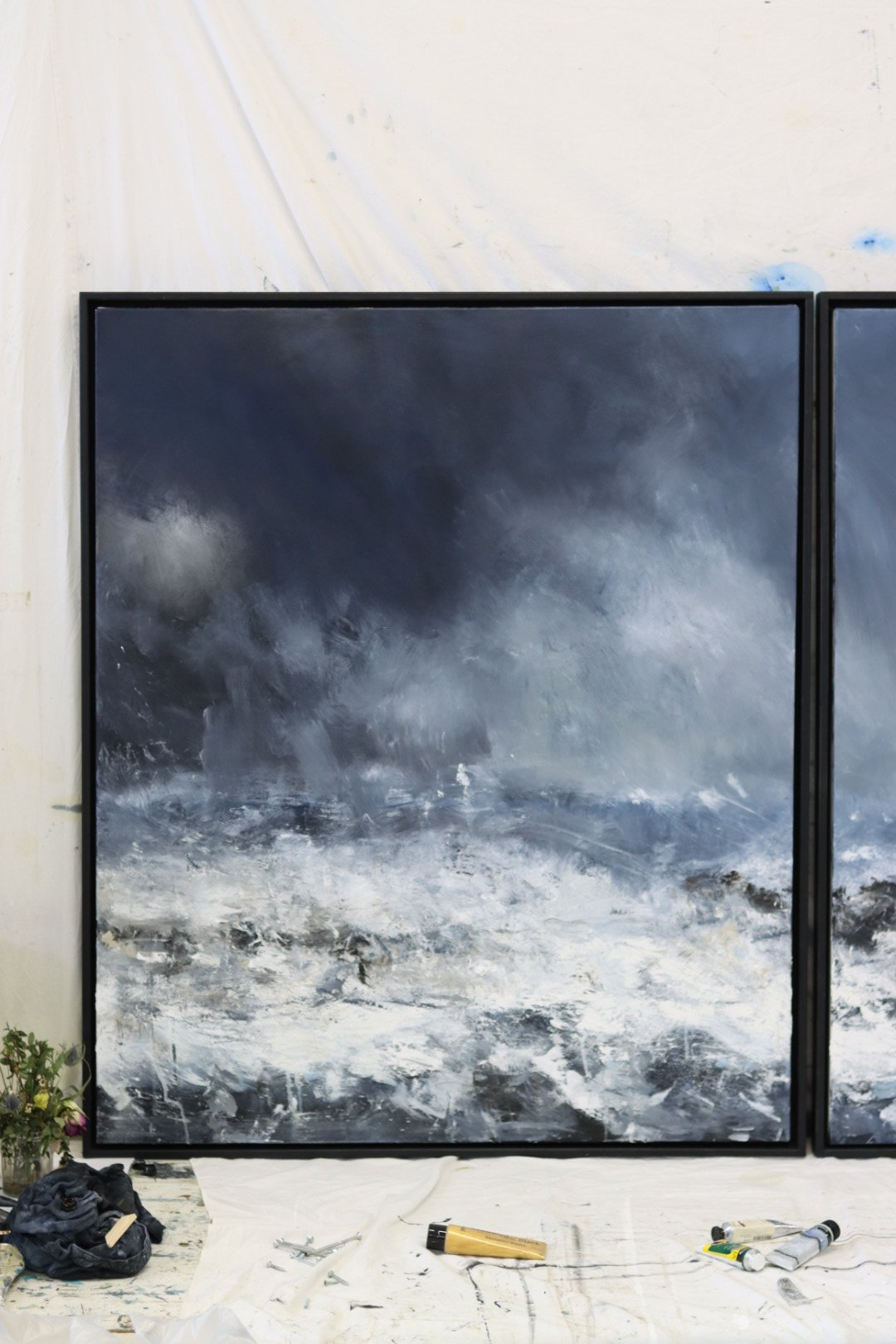
Working on a large canvas changes the act of painting itself. A small painting can be worked on almost entirely from the wrist and fingers. The movement is delicate and contained. But when the canvas grows, the whole body becomes involved. The arm extends further. The shoulder and torso begin to move. The painter steps forward and back, again and again, judging the painting from different distances. There is a rhythm to it.
The act of painting large becomes almost choreographed. One moves close to the surface to place paint, then steps back to see how the marks gather together. The body learns the distance between intention and result. It learns when to lean in and when to retreat. Sometimes the painting demands sweeping movement. Other times the marks remain small but must travel across a wide expanse of canvas, creating a field of activity that can only exist at that scale.
The studio changes when a large painting is in progress. The canvas occupies the room differently. It becomes less like an object and more like a presence. You find yourself adjusting your position constantly, walking around it, considering it from unexpected angles. The painting becomes something you inhabit rather than something you simply make.
Light behaves differently across a larger surface as well. Texture becomes more visible. The ridges of paint catch shadows during certain hours of the day. A mark that might feel excessive on a small canvas can suddenly feel necessary when it sits within a broader field of colour.
Large paintings are also strangely forgiving. Mistakes that would dominate a small work can disappear within a wider composition. A bold gesture can exist without overwhelming everything around it. Space allows for movement and correction. The painting can evolve in ways that feel less constrained.
Yet scale also introduces its own challenges. A large painting asks more questions of the artist. It requires patience and stamina. There are moments where the work feels unresolved simply because the surface is vast and still waiting to be explored. You can find yourself standing in front of it wondering where the next mark should land.
It is not unusual for a large painting to go through several phases of uncertainty. There are stages where it appears chaotic. Areas of colour might feel disconnected. Sections of the canvas remain untouched while others become dense with paint. The painting seems to hover between possibilities, neither fully formed nor entirely lost.
But slowly, almost imperceptibly, something begins to happen. Relationships between colours start to emerge. Movement appears where before there was only scattered gesture. The painting gathers itself together. What once seemed disordered begins to feel intentional.
Often this transformation occurs when the artist stops trying to control the painting too tightly.
Large paintings have their own logic. They resist over-management. They ask the painter to trust the process, to allow space for unexpected moments to develop. Some of the most compelling passages in a painting arrive through this balance between intention and accident.
Nature itself works in this way. A wild meadow, for example, is not arranged carefully like a bouquet. It grows in layers, with plants appearing where they can, responding to light and soil and season. The beauty of it lies partly in its irregularity. There is structure within the apparent chaos, but it is not imposed artificially.
When painting large works inspired by hedgerows or wildflowers, I often think about this natural rhythm. The marks need to feel alive rather than organised. They must move across the canvas with the same unpredictable energy found in the landscape.
Scale allows that movement to unfold. A cluster of colour can travel across a metre of canvas, expanding and dissolving as it goes. A gesture can begin in one corner and echo faintly elsewhere. The painting becomes a kind of visual terrain.
This is perhaps why collectors often describe large paintings differently from smaller works. Rather than saying they are looking at the painting, they sometimes say they feel drawn into it. The painting becomes something atmospheric. It holds space within a room. It shifts the mood of the environment around it. Large works can change how light moves across a wall, how a room feels when you enter it.
This is not something that can be forced through size alone. A painting must earn its scale. If the composition does not support the format, the work can feel empty or exaggerated. But when scale and subject align, something remarkable can happen. The painting begins to carry a sense of presence. It becomes less like a picture and more like a fragment of landscape or atmosphere brought indoors. It invites the viewer to pause, to spend time with it, to notice small movements within the surface.
In this way, large paintings share something with the natural environments that inspire them. Standing beside the sea or walking along a hedgerow, one rarely experiences the landscape in a single glance. The eye moves slowly, noticing details gradually. The experience unfolds over time.
A large painting can offer something similar.
It does not reveal everything immediately. Instead it allows the viewer to explore its surface, discovering shifts of colour, texture, and gesture. The painting rewards patience.
Of course, not every painting needs to be large. Some ideas arrive quietly and remain small, perfectly contained within their format. But occasionally a subject demands more space. It asks for breadth, movement, atmosphere. In those moments the painter simply has to listen. Because some paintings, from the very beginning, are already larger than the canvas you first imagined.